
When communication has become strained, mediation provides a respectful, structured space for families to talk, be heard, and find a way forward — with the support of an experienced, impartial facilitator.

Family life is filled with moments when conversations become difficult. Simple discussions can turn into arguments. People who care deeply about one another sometimes find themselves unable to communicate in ways that lead anywhere helpful.
Whether it arises slowly over months, or suddenly in a period of upheaval, the breakdown of communication within a family can feel isolating and overwhelming. Separation, disagreements about children, financial concerns, or long-standing conflict can all create moments in which finding common ground seems almost impossible.
Mediation offers something different — not a formal legal process, not a place to determine who is right or wrong, but a guided conversation where all parties are heard with equal care, and where the focus is on understanding, clarity, and a way forward.
"Behind every difficult conversation is a family looking for a way to move forward."
Attempting difficult conversations without support can lead to misunderstandings, escalation, or silence. A skilled, neutral mediator changes the dynamic in three significant ways.
The mediator does not advocate for either party. Their role is to ensure the conversation stays respectful, balanced, and constructive — so both parties feel equally heard and treated with care.
Mediation provides a framework that keeps conversations productive without feeling formal or adversarial. The pace is unhurried, and space is made for reflection before decisions are reached.
Rather than relitigating past grievances, mediation gently steers discussions toward what will work in the future — especially for children and for the ongoing relationships within the family.

Understanding the process can ease the uncertainty that often surrounds the first steps into mediation. It is a measured, human-centred approach from start to finish.
Each person meets separately with the mediator. This introductory session allows individuals to explain their situation, ask questions, and understand what the process involves — all without pressure. It also allows the mediator to assess whether mediation is appropriate and how best to proceed.
Once both parties are comfortable moving forward, joint sessions begin. The mediator guides the conversation, ensuring everyone has an opportunity to speak without interruption and that discussions remain respectful. Sessions are not rushed — the process allows for genuine dialogue and careful consideration.
Rather than jumping to solutions, mediation begins by exploring the concerns and priorities of each person involved. This deeper understanding of what is truly at stake makes subsequent conversations more meaningful and more productive.
As the conversations develop, practical arrangements can begin to take shape. Whether addressing parenting schedules, financial matters, or communication guidelines, any agreements reached are documented clearly so that all parties have a shared written understanding.
Everything discussed within the mediation process is treated with the utmost discretion. This confidentiality creates the safety that allows for more open, honest, and meaningful conversations.
Every family situation is unique, and mediation is a flexible process. It can be adapted to a wide range of circumstances and relationship dynamics.
When a relationship reaches a turning point and practical decisions must be made — about living arrangements, shared responsibilities, or finances — mediation provides a structured, calmer environment to work through these discussions.
Parents who are separated but remain connected through their children often benefit from mediation to establish clear, respectful communication patterns and practical arrangements that serve everyone involved.
Grandparents, adult siblings, and members of blended families sometimes face disagreements that benefit from structured, impartial facilitation — whether regarding family roles, financial matters, or shared responsibilities.
When conversations at home have repeatedly ended in conflict or silence, mediation reintroduces structure and safety to allow dialogue to begin again — often with results that feel genuinely different.
There is no single reason families seek mediation. The circumstances vary enormously, and mediation can be adapted accordingly. Below are some of the most common situations.
Navigating the practical and emotional dimensions of a relationship ending, including living arrangements and shared responsibilities.
Agreeing on where children will live, how time will be shared, and how routines will be maintained across two households.
Establishing respectful, practical ways to communicate about children's schooling, health, activities, and daily life.
Addressing shared assets, property, or financial responsibilities in a balanced way — particularly during periods of transition.
When new relationships form and expectations need to be negotiated across a more complex family network.
Disagreements between grandparents, adult siblings, or other family members where a neutral facilitator can help reach understanding.
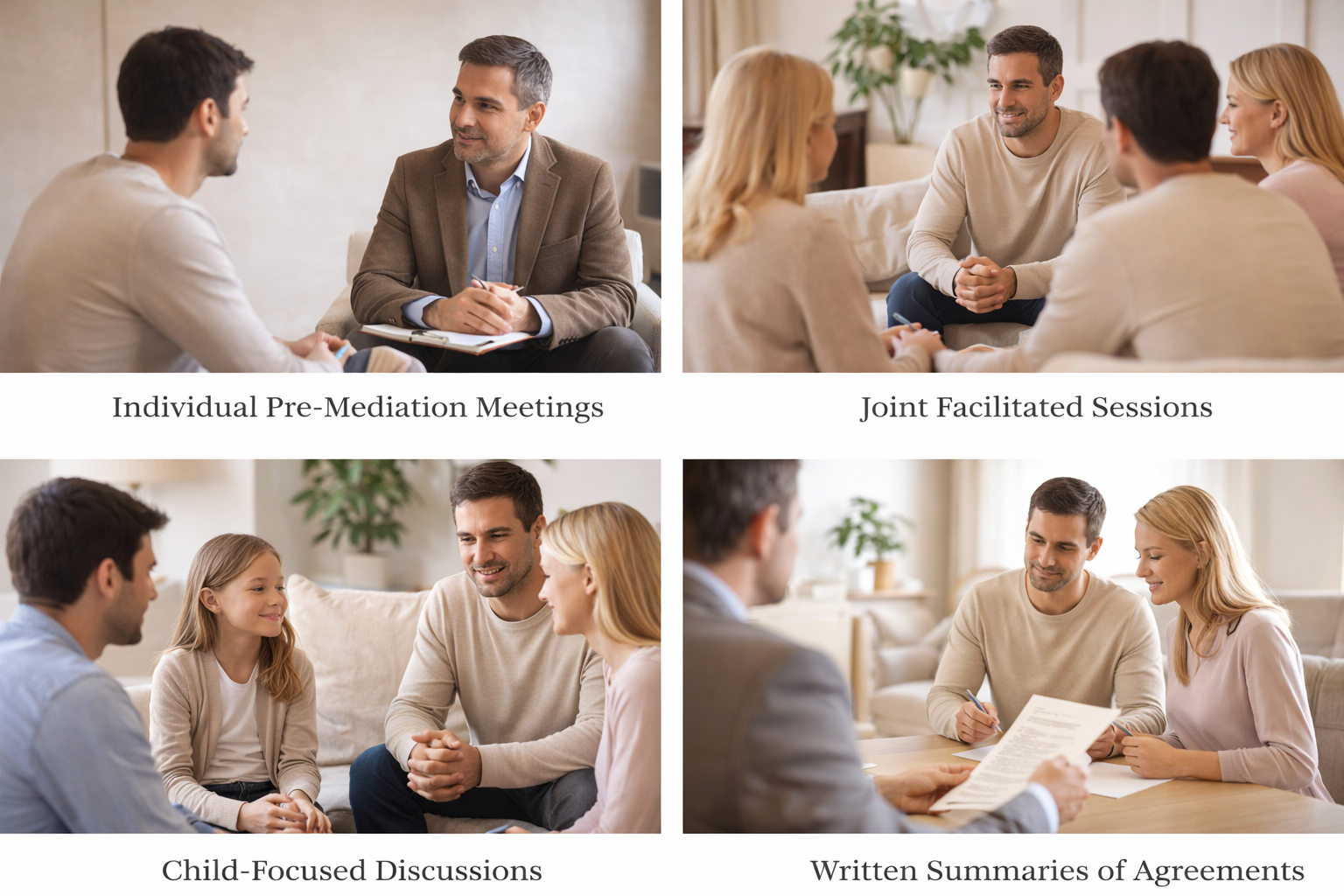
No two mediation journeys are identical. The process is shaped by the individuals involved and the nature of what needs to be addressed. Understanding what different stages of mediation involve can help people feel more prepared and at ease.
Mediation is not a guarantee of full resolution, nor does it promise that all disagreements will disappear. What it does offer is something many families find genuinely transformative — a shift in how conversation feels and what becomes possible.
For most families, the change is gradual. Over the course of mediation, many participants notice that conversations begin to feel different. Where there was previously tension or silence, there is dialogue. Where solutions seemed impossible, they begin to appear achievable.
Many families find that even when full agreement is not reached on every point, the quality and tone of ongoing communication improves significantly.
When parents are able to make practical, agreed arrangements, children benefit from more consistency, security, and the reassurance that both parents remain involved.
Families often describe feeling, for the first time in a while, that the way ahead is manageable. Mediation does not remove complexity, but it can make complexity feel navigable.
The effectiveness of mediation depends entirely on the quality and safety of the environment in which it takes place. A professionally facilitated mediation holds several non-negotiable commitments to all participants.
Impartiality — The mediator does not take sides, advocate for any outcome, or allow the process to become weighted toward any one party.
Confidentiality — Everything discussed within mediation sessions remains private. This creates a safe space for honest, open conversation.
No coercion — Agreements are never pressured or rushed. Any outcome reached in mediation must feel genuinely acceptable to all involved.
Voluntary participation — Mediation works best when all parties choose to engage. No one is compelled to continue, and the process can be paused or stopped if it no longer feels appropriate.
Emotional awareness — A skilled mediator recognises when emotions are running high and adjusts the pace and tone of the conversation accordingly.
"Mediation is built on the principle that every person in the room deserves to be heard with equal dignity and care."
Core Mediation Principle
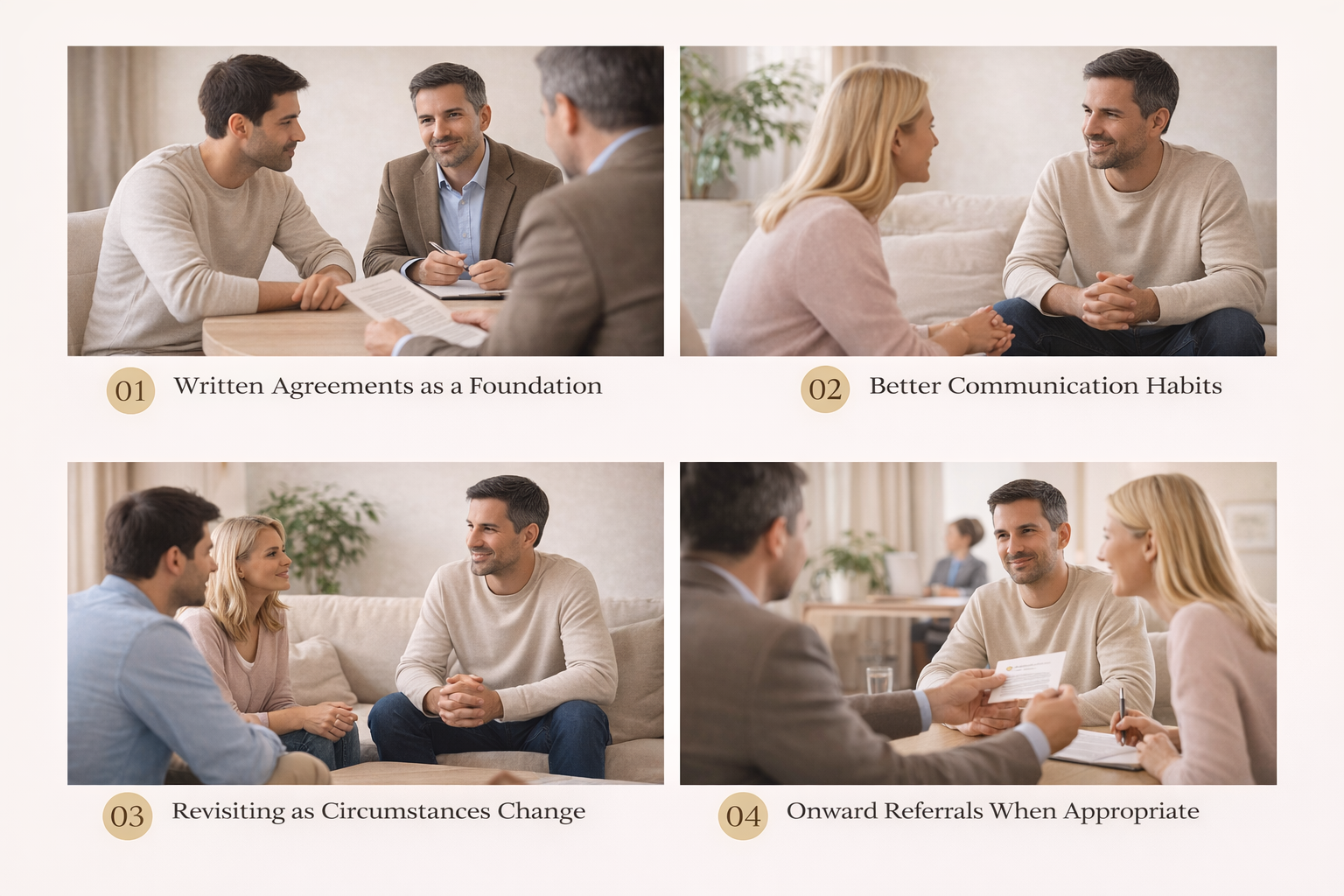
The work that takes place in mediation does not simply end when sessions conclude. For many families, mediation marks the beginning of a more constructive way of communicating — not a one-time event, but a shift in approach.
Where practical agreements have been reached, a written record provides clarity and a point of reference for both parties going forward. This reduces the likelihood of misunderstandings arising at a later stage.
Many participants find that mediation helps them develop more effective and respectful ways of communicating — skills that continue to serve them in future conversations, particularly where children are involved.
Family life evolves. Children grow older. Circumstances shift. Mediation can be returned to if new questions arise or existing arrangements need to be revisited — without returning to the conflict that once felt inevitable.
Mediators will always signpost to other appropriate support when it is evident that additional professional guidance — legal, financial, or therapeutic — would benefit those involved.
We had reached a point where every conversation turned into an argument. Mediation gave us a space to talk where neither of us felt attacked, and slowly things started to shift. By the end, we had made plans we genuinely felt good about.
I was worried about how our separation would affect our children. The mediation sessions helped us focus on what they needed rather than on what had gone wrong between us. It felt like the conversation finally moved forward.
I did not expect to feel heard so quickly. Having someone impartial there made an enormous difference — not because they told us what to do, but because they helped us listen to each other in a way we had forgotten was possible.
At the centre of effective mediation is something deceptively simple — the belief that most people, when given a respectful space and proper support, are capable of finding their own way forward.
Some conversations take time. The mediation process is never rushed, and the pace is always guided by what participants need, not by an external agenda.
Family situations carry deep emotion. An experienced mediator acknowledges this openly, creating space for feelings to be expressed without allowing them to derail the conversation.
Both parties must feel that the process is genuinely fair. Only then do people engage openly — and only then does real progress become possible.
Rather than returning repeatedly to past grievances, mediation turns attention toward what will work going forward — particularly for families with children.
"When safety surrounds, and there is a neutral sounding board to help guide the dialogue, possibilities start to emerge. That is the premise of what good mediation does — it creates the conditions for a real conversation again."Barker Mediation Practice Philosophy
Family conflict can leave people feeling uncertain about the future. When emotions are unresolved and communication has become strained, even the most important decisions can feel overwhelming.
Mediation offers a route toward clarity. Through careful conversation, genuine listening, and thoughtful consideration of what matters most, families are often able to glimpse possibilities that once seemed out of reach.
Not every disagreement disappears entirely. But most families find that mediation helps them move forward with more dignity, greater stability, and a better understanding of one another — and sometimes, that is exactly what is needed to begin heading toward a more peaceful future.